It’s that time of year again. Spring, when a young man’s fancy turns to thoughts of financial disclosure—specifically your customers’ annual reports. This is the time of year when most of the 2015 reports come out, and I like to remind my readers that now is the time to download a copy, read it, and use the information gained to keep up with your customers and if possible develop fresh insights based on their changed environments. Even if you’re already doing a good job of keeping up with developments, it’s useful to peruse for clues about where they are going in the year ahead.
But I fear it’s a losing battle, and I doubt my feeble attempts to remind you do much good. I say that because of an article in last Saturday’s Wall Street Journal: “It’s Time to Re-Learn the Lost Art of Reading.” In the article Jason Zweig urges investors to read annual reports, and laments the fact that it seems to be a dying practice. He cites research by a Notre Dame finance professor who found that only 29 people a day download the average annual report when it comes out. (I wonder how many of those are salespeople?) “Even General Electric’s annual report was downloaded from GE’s website only 800 times in 2013”!
You can glean a lot from reading an annual report, but even if you don’t get any specific actionable information, it’s extremely helpful to earn the right to speak to higher level decision makers and show that you are interested in impacting their business results, not just pushing products into their pipeline. And if nobody is reading them nowadays, what a terrific opportunity to stand out as someone who has.
So, as soon as you finish this paragraph, do yourself a favor. Go straight to the Investor Relations section of your top customer’s website, download their 2015 annual report, and then read it. You don’t have to read the whole thing cover to cover, but you should definitely read the Chairman’s Letter, peruse the numbers, and check out Management’s Discussion of Financial results. To glean specific tidbits, use these questions I furnished in a previous reminder.
To clarify why clarity is important in selling, let’s go back to the purpose of lean communication: to improve the listener’s RoTE, or Return on Time and Effort. By being clear in your sales communications, you help your buyers by reducing their effort to receive and process your message in the way you intend. So, by being clear you make it easier on your buyer and you reduce the risk of misunderstanding at the same time.
As if the benefit to the buyer were not enough, clarity in your communications will also help you sell in three ways: it will increase your personal believability, make your message more convincing, and make action more likely.
Your personal believability goes up; you will sound authentic for the simple reason that you will be authentic. People can sense when you are being yourself rather than a sales persona put on for their benefit, and they will respond to that. At the same time, if you have trouble explaining something simply, others may infer that you don’t understand it yourself.
Second, as Daniel Kahneman tells us, easy = true.[1] This is shorthand for saying that things that are easy to grasp are equated in our minds with truth. The easier it is to understand something, the more it sounds like “common sense”. No one likes to work any harder than necessary, and if the “package” your message comes in is hard to open, they may not make the full effort.
Finally, clarity will make action more likely in two ways. In the sense of simplifying the choices for your buyer, clarity increases the likelihood that they will buy. You may be familiar with the experiment in which researchers set up a jam tasting table in a grocery store. When they had 24 flavors on display, more people stopped to try a sample; when there were only six choices, fewer people stopped by, but they were more likely to purchase and to report greater satisfaction with their purchase.[2] And in B2B sales, if you want someone to be a champion for you internally, it’s going to be much less likely if they find it difficult to grasp the complexities of your message.
How to be more clear
The first rule of clarity is to be candid and direct. As I’ve written before, candor is a choice about whether to say something and directness is how you should say it. As a salesperson, want to present your solution in the best possible light and you don’t have an obligation to expose every single wart or deficiency—your competitors will do that for you. But if asked about a weakness, you should answer the question candidly and directly without dancing around; and you can also earn a lot of respect by bringing it up yourself before being asked about it. (presponse)
In general, lean communication is biased to being as direct as possible, but directness is a trickier matter in sales conversations for two reasons. First, if you know that your competitor’s offering has a glaring weakness, it might be more professional or prudent to be less direct about it. Second, it’s easy to provoke a backlash by being too direct and telling the customer all the reasons they should buy from you—it’s usually better to make it their own idea by leading them to conclusions indirectly through questioning.
The second rule of clarity is to employ user-friendly language. Put it in terms they will understand, and just as importantly, remember when it comes time to make a decision. When things are vague or abstract, they are less likely to be understood and remembered. Make your key points easier to grasp by using Q-SAVE:
Quantity: Although numbers may seem like the ultimate abstraction, they are actually the best way to make something real and meaningful. You can say your solution speeds up their process, or you can tell them it makes it 17% faster, which translates to $3.4 million in additional revenue. And try to use their own numbers when possible for rock-solid believability.
Story: A story is the leanest communication tool you can use, because it can pack the most power into the fewest words—as long as you select the right one and tell it right. In sales, the most convincing stories are those about similar customers who faced the same situation.
Analogies: Analogies make foggy ideas clear by connecting them to the familiar, and a well-chosen one can snap your listener into instant focus. The most powerful analogies are those that compare something to the buyer’s own company. For example, when pressed on price, you can use the analogy of their own sales force with their own customers to stress the importance of selling on value.
Visuals: The cliché, “a picture is worth a thousand words” is true: despite the common misconception that people have different sensory preferences, the fact is that we are all visual. But that also means that you should be very careful about what pictures you put into presentations. Drop all the canned and posed pictures of products and satisfied customers—they won’t add any value but they will be remembered.
Examples: Examples clarify by making things real in the buyer’s mind, and they make you more credible. A good example of this is DILO selling, where you show how using your solution will make specific improvements in the “Day In the Life Of” the end user.
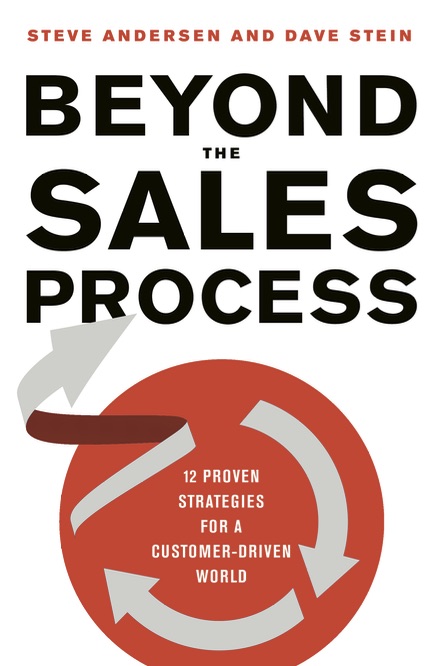
Beyond the Sales Process, by Dave Stein and Steve Andersen, is my kind of book, because it takes a big picture view of B2B sales. Here’s the gist: many B2B sellers get in too late and leave too soon. If you engage with potential customers only during their active buying efforts, you’re like the drunk looking for his lost keys under the streetlight—just because the light’s better there.
Stein and Andersen make the point that even with complex B2B sales, buyers might actively buy from you only about 2% of their total time in a year. Most sales books focus their prescriptions, during that narrow 2% window called the sales process, when the buyer is actively seeking to fill an identified need. The problem with that is that while there is a need, there is also a lot of competition and very little trust.
If you want to achieve the status of trusted advisor, you have to pay attention before, during and after the sales process. They delineate 12 strategies, distributed equally across the entire life cycle, what they call Engage, Win and Grow.
Engage
This is the pre-opportunity phase in which you do in-depth research to understand your customer’s business and use the insights gained to earn the right to engage with your customers in elevated discussions about what they need to do to achieve their business objectives, how you will help them do it, and why it’s important. I’m vastly oversimplifying here, of course, but the general idea is to put yourself in a position where you can credibly be seen as a potential trusted advisor by the right people in the customer’s organization before a specific opportunity comes up. By doing so, you will be in a position to influence and shape their needs and hence their requirements.
Win
This phase is the main focus of approaches that focus on the meat of the sales process: the pursuit of opportunities from identification through the sales funnel to closing. The four chapters in this section will be familiar to anyone who has experience and training in common sales methodologies: they cover the fundamentals of discovering the key drivers that relate to the specific sales opportunity, and how to use those to deliver “actionable awareness,” which is a key point that I personally believe many B2B salespeople miss. They know the importance of learning about their customer’s business, but most of them use their research to gain data points that they can use to sprinkle in their product pitches to give them a veneer of “customer focus” and business sophistication. Scratch beneath surface, though, and you find they don’t truly bring key insights that show how they can uniquely impact the customer’s business.
Grow
There are very few feelings as exhilarating as winning that big deal of the year, but you have to resist the temptation to take your eye off the ball at this point. If you keep your attention in the post-sale phase to realizing the value that was promised during the win phase and validate its impact on the customer, adapt to changes and issues as they arise, and expand the relationship, you will have a firm launching pad for all future opportunities that arise.
If you’re a sales professional who has already read many of the excellent books that guide you through the sales process, Beyond the Sales Process is an excellent complement that will illuminate the rest of the sales landscape and expand your view of what it takes to raise your game.
How important are relationships in today’s fast-paced, information-rich and ultra-connected world? Traditionalists contend that human nature does not change, and people will always prefer to buy from people they like, no matter how much the world has changed.
Others will tell you that selling has changed, and relationship selling is dead. The authors of The Challenger Sale, Matthew Dixon and Brent Adamson, tell us in a Harvard Business Review article that “Selling is Not About Relationships.” They tell us that Relationship Builders are not only the least effective of the five types of sellers, but they become less and less successful as the complexity of the sale increases.
I believe that not only is relationship selling not dead, it is more important than ever—but the basis of those relationships has changed. It’s not about friendship (although that does not hurt), it’s about TRUE relationships.
Keep in mind that buyers face a more complicated decision process than ever for various reasons. Products and services are more complex than ever, because they contain and rely on increasing amounts of information technology, and that technology changes more rapidly, leading to a wider and more confusing set of choices for every purchase. The sheer amount of readily accessible information might seem to be the panacea for all these ills, but it usually adds to the problem as it becomes harder and harder to sift valuable insights out of the waste. With more and more information funneling through the same attention span and working memory limitations, the quality of information sources becomes paramount.
If you know the right questions to ask, one trusted and credible source can provide more valuable and less risk than of hours of searching dozens of websites and hundreds of pages of technical data and misleading or untargeted marketing information. And if you don’t know the right questions to ask, a trusted source can be even more valuable.
Here’s a simple example: when I decided last year to begin recording training and marketing videos, I had to start from scratch. I googled, searched, read, compared, scratched my head for hours, and at the end was still unsure of what software to buy and how to set up my studio. Then I called John Spence, who told me more in a half hour than the hours I had spent before calling him.
So, I think it’s self-evident that relationships such as that can and do matter as much as they always have in B2B sales. But the basis of that relationship probably has changed, or maybe just needs reminding. Don’t confuse a relationship with a friendship. They can overlap, of course, but in business the old saying applies: “If you want a friend, get a dog.” Today, a valuable professional sales relationship is a TRUE relationship, based on Trust, Reliability, Understanding, and Economic value.
Trust: When you earn the customer’s trust, you do two things for them: you reduce their risk of acting on the information you provide, and you save both sides time because they need to do less cross-checking and verifying of what you tell them. Do you tell the truth all the time? Do you have the customer’s best interests at heart? Do you have good intentions? Are you willing to risk your friendship to tell them things they don’t want to hear, but should?
Reliability: While trust is about your intentions, reliability is about your ability to deliver on them. Are you an effective advocate and agent for your customer’s interests within your own organization? Do you deliver at least as much as you promise? Are you punctual and responsive, and can you be reached when they need you?
Understanding: These next two go hand in hand. You can create far more value for your customer when you fully understand their business and personal situation. This turns the old sales adage on its head: they don’t care how much you care until they know how much you know. Do you seek first to understand before trying to be understood? Do you know their business drivers, their goals, internal challenges, and opportunities?
Economic Value: The sustainable basis of a professional sales relationship is the outcomes it produces, and in business these are measured by economic value. Do you deliver some or more of the four tangible economic outcomes—revenue growth, cost and risk reduction, and asset efficiency? Can you help them with their intangible but no less valuable outcomes such as achieving business objectives, initiatives and strategies?