
Practical Eloquence Blog

Clear thinking - Lean Communication

Bad Simplicity, Complexity, Good Simplicity

The best way to add value and reduce waste in communication is to provide your audience with “simplicity on the other side of complexity”.

I first came across this phrase in a fascinating blog post titled: Simplicity on the other Side of Complexity, by John Kolko, and he in turn took it from Chief Justice Oliver Wendell Holmes who said, “I would not give a fig for the simplicity on this side of complexity, but I would give my life for the simplicity on the other side of complexity.”

The phrase resonated with me because it explains so clearly an idea that I am constantly trying to impart to participants in my lean communication and presentations classes. One of the most common reasons that companies bring me in to work with their teams is that their executives complain that they have to sit through unnecessarily complex and excessively detailed presentations, where masses of data substitute for clear understanding. The common complaint is “I ask what time it is, and they tell me how to build a watch.”

When you have to make a presentation to busy high-level decision makers—whether internally or to a potential customer—it’s because they need information to grasp the key issues about a complex decision, so that they can take effective action to improve outcomes. The simplicity with which you express information clearly adds value to them, because it reduces uncertainty and saves time and effort. But only if it’s good simplicity, which resides on the other side of complexity.

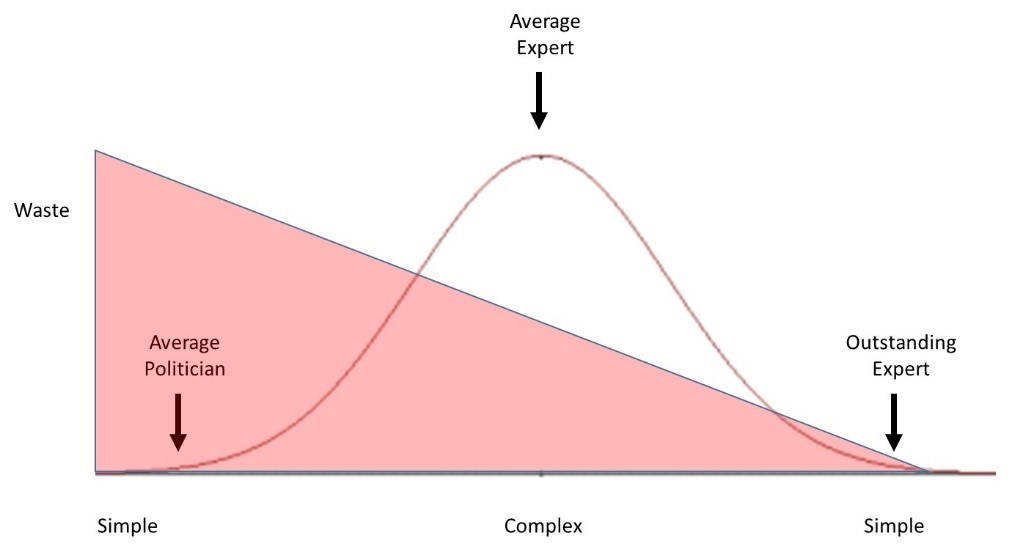
In essence, the gist of Kolko’s article is that the learning curve for a complex issue looks like a bell curve (I’ve added the labels to his simple drawing, and the rest of this article includes my additions to his):

simplicity curve 2

At the far left, when people first approach an issue, they know very little about it, but of course that doesn’t stop most of them from jumping to conclusions or forming opinions. People who are intellectually lazy or who use motivated reasoning don’t proceed past this stage and enjoy the confidence born of ignorance. They forget what H.L. Mencken said: “Explanations exist; they have existed for all time; there is always a well-known solution to every human problem — neat, plausible, and wrong.” For examples of this type of presentation, just think back to the past two weeks of US Presidential conventions. This kind of simple is almost pure waste, because it’s either wrong, or it’s trivial.

But you’re a business professional, so you can’t afford to be intellectually lazy because you know if you present a simplistic and shallow case you will be eviscerated in the boardroom. So you take your time, gather evidence and analyze it, and see greater depth and nuance in the issues. If you stick to it, you eventually become an expert; you “get it”, so that’s the next natural stopping point. Complexity is the point at which the average expert feels they are ready to present their findings. However, the biggest mistake they make is that they include far more detail than the listener needs to use their findings, either through defensiveness or inability to connect to what the listener cares about. As one CEO told me, “I get a lot of detail but very little meaning.” They may have added value, but there is still a significant amount of waste, in the form of time, effort, and confusion.
simplicity on the other side of complexity

Outstanding expert presenters know that you never truly know how well you know something until you try to explain it to others, so they take the next logical step. They add value to their listeners by distilling all their hard-won complexity into just the meaning the listener needs for their purposes. They know exactly why the listener needs the information, and give them just what they need to know to make the best possible decision, so that there is zero waste. Most times, they go beyond merely providing information and advocate for a specific decision (which is a given if it’s a sales presentation)—but it’s based on highly informed judgment.

The tools for achieving this type of good simplicity are the tools of lean communication: Outside-in thinking to know what the listener needs, Bottom Line Up Front to provide meaning right away, SO WHAT filter to root out waste, and pull to make adjustments as necessary.

Before you decide to strive for good simplicity, I would be remiss in not pointing out one personal risk you might run: if your goal is to call attention to how smart you are, it may not be the best way. As Kolko says, “The place you land on the right—the simplicity on the other side of complexity—is often super obvious in retrospect. That’s sort of the point: it’s made obvious to others because you did the heavy lifting of getting through the mess.”

But if your goal is to get the right things done, simplicity on the other side of complexity is the only way.


Read More
Lean Communication

Transparency Is a Fundamental Key to Lean Communication

Taiichi Ohno, a founding father of lean thinking, said, “Eliminating waste is not the problem. Identifying it is.” Although he was referring to manufacturing, the same thing applies to communication. The surest way to identify waste is to be as transparent as possible, both to the listener and to yourself. It also can contribute directly to value.

Transparency adds value: Transparent communication adds more value in the form of better outcomes and stronger relationships. Outcomes can be better because it helps both parties align more quickly on a shared goal, and common view of the situation. Two heads are only better than one when they are working together, and that’s most likely when they can clearly grasp each other’s thinking. Transparency also leads to more trusting conversations and relationships in three ways: it reduces suspicion, makes you more authentic, and invites reciprocity.

Transparency reduces waste: Transparency reduces three major forms of waste in communication: time, effort and errors. When people are clear about your purpose and the logic behind it, they get it faster and expend less mental effort, and it’s far less likely that you will have misunderstandings. Surprises, problems and misunderstandings surface much more quickly and even if the other party disagrees with you, they are more likely to let you know where they stand, and specifically why and how they disagree.

How to be transparent

If you think of every communication as a pyramid, you can ensure transparency at all levels; begin with your bottom line at the top, lay out your logic at the next level, and then support it with a clear base of evidence.

Make your purpose and motives visible

Lean communication is not a joke, which is why it starts with the punchline. Be very clear about your ask at the beginning of any communication. This directness and transparency is both respectful and efficient. It’s respectful because it allays suspicion and confusion, which is what people will feel if they’re unsure what you want from them. It’s efficient because if they know your intent early, it makes it easier for them to process and understand your reasoning. It saves time because they will listen until they’ve heard enough; it also surfaces objections early, so you can deal with them.

Show your logic

Make your work visible by making your thinking visible. You can do this in several ways. Up front, you can give a synopsis of your position or even lay out a formal agenda. During the conversation, use signposts so that it’s clear where you are in the story or argument. Besides making it clear to the other person, you make it clear to yourself because sometimes you don’t know what you truly think about something until you try to put it on paper, which I discover almost every time I write a blog post or prepare a presentation.

Be clear in your words

Use common, short and concrete words whenever it’s possible to do so without losing precision. It’s easy to talk over someone’s head, either inadvertently when you forget that they don’t know as much about the topic as you do, or on purpose, when you try to make yourself sound more intelligent by puffing up your vocabulary. Of course, you don’t want to overcorrect and talk down to your audience, which is why it’s important to use outside-in thinking to better understand what will resonate, and this includes using analogies and examples that your audience is most familiar with.

Use the pull system

Like a manufacturer trying to forecast demand, you can never be sure you’re delivering just the right information at the right pace to the right people, so your ultimate tool is the pull system—let your listeners pull the information they need to receive value. Encourage them to interrupt with questions to clarify things you say, or to ask for more or less information on a particular topic. Since a lot of people are afraid of “asking a dumb question”, you also have to be constantly paying attention to their reaction, so you can draw them out when you see that they’re getting confused.

Read More
Sales

You Get Sent to Who You Sound Like

Are you planning an overseas vacation this summer? If so, have you picked up a phrase book to learn a few useful phrases?

We Americans are probably the least likely to do so. When we visit a foreign country, we expect that everyone else will speak English, and very few of us make the effort to pick up even a few words. We find that it generally works OK as long as we stick to the crowded tourist spots where the locals have learned English so that they can sell things to us. So, we take the path of least resistance and miss out on so much of the country.

But if you do venture out to areas where English is less common, at some point you’ll probably have to communicate with someone who does not speak your language. You’ll notice that you speak louder and slower, as if shouting will get the meaning across the language barrier. What happens instead is that both sides get confused and annoyed, and communication fails. In the end the other person either walks away or if they are polite, they direct you to someone who speaks your language.

While this can make for a humorous scene in a comedy, unfortunately it’s all too common and far more serious when it happens in a sales call—except that usually the language barrier is not between English and Spanish or French, but across different “languages” that salespeople and customers speak.

Most salespeople speak the language they are most comfortable with—it’s called “product-speak”. This is natural, because they know their product better than anything else, they’re well-trained in its vocabulary, and it’s the language they speak with each other when they talk shop. So, when they venture out into a new prospect’s decision process, they expect that everyone else will speak the same language. If they find someone who understands the language, they stay in their comfort zone.

The problem with staying here is that they miss out on so much potential value, and they jostle with every other competitor who is also spending time here. The bolder salespeople venture outside the comfort zone where the real value is—but if they go unequipped to speak the language, it’s not much better than staying put. When they begin spouting product-speak at senior decision-making levels, they run the risk of a communication fail, and end up getting sent back to the “appropriate” level. As the old saying goes: in sales, you get sent to who you sound like.

The ones who venture out successfully are the ones who make the effort to learn and speak the local language. Depending on the level, the right language is either process-speak or business-speak.

Process-speak means understanding the nuts and bolts of the actual business processes or operations that your customer uses to add value to their customers, and which your solution impacts. It requires an intimate understanding of the inputs, steps, operations, and outputs. Can you help your customer make their processes faster, cheaper, better, or more reliable? Can you express those improvements in measurable terms? If so, you have the language skill to succeed at this level, and it’s usually higher and more influential than the product level. In some ways, process-speak is the hardest language to master, because every industry is different and has its own specialized processes.

Of course, some processes are complex enough that you will always benefit from having a sales engineer to translate, but it’s always useful to know enough so that you know what you don’t know.

Business-speak is spoken at the highest levels in the decision process. It’s the most intimidating for product-speak salespeople, but it’s actually easier to learn, because all businesses use a common financial language. It’s not that difficult to learn: once you pick up the terminology of financial statements, most of it is simply basic arithmetic. The first step is to get a copy of your customer’s latest annual report. You can get an excellent basic education from reading the Management’s Discussion of Financial Results section. If you get stuck on some of the terminology and concepts, I would highly recommend my own book, Bottom-Line Selling, which explains what they mean in SO WHAT sales terms.

There’s a big difference between a tourist and a traveler. The tourist flies in for a few days, a week or two at most—and spends time only where everyone else is and just skims the surface of the experience of being in that country. A traveler stays longer, ranges wider, and invests time and effort to read about the history and culture of the destination, as well as to master a few words and phrases. Tourists expect others to adapt to them, travelers adapt to others, and they know that making the effort conveys respect and opens more doors than a sense of language entitlement.

If you are going to have long term success in high-end complex B2B sales, there is no alternative to becoming fluent in more than one language.

Read More
Book reviews - Sales Books

Book Recommendation: Sales Manager Survival Guide

Imagine that you’ve just been named a first-line sales manager. You’re proud, you’re excited, and you’re about to be overwhelmed by the demands of the job. It is one of the toughest jobs in business. You’re going to quickly find out that what got you there won’t keep you there; the skills that got you promoted as an individual contributor don’t translate directly to getting work done through others. To top it off, your company spends a minuscule amount of its sales training budget on sales management skills.

Sounds like a sure-fire recipe for failure, but fortunately you have a wise mentor—let’s call him Dave—who has decades of experience in the sales trenches, and even more importantly knows how to impart that wisdom to others. This mentor helps you get oriented to the job and gives you excellent guidance about how to navigate and survive the crucial first 90 days. Building off that, he schedules regular sessions with you to focus on critical building blocks of sales management success, such as coaching, hiring, managing performance, and practically everything else you need to know to not only survive but thrive.

Your sessions with him are succinct, direct and powerful; he doesn’t waste your time with vague management theories; and he’s always completely candid with you. With that kind of coaching and mentorship, as long as you heed the advice and do the work, it would be almost impossible not to succeed as a front line sales manager!

Sounds too good to be true, doesn’t it? Actually it’s mostly true. He does exist, his name is Dave Brock, and the only thing wrong with the scenario I just mentioned is that you probably can’t afford for him to spend time with you personally each week. But you can buy his book, Sales Manager Survival Guide, and get the same benefits. If you are a first time sales manager, this book will launch you in the right direction, and if you’ve been in the role for a while, it may help you make whatever mid-course corrections you need to assure success.

All that said, I have to be completely candid. I’m a bit biased, having known Dave for over 25 years, first as a client, next as a sales training partner (which is why I know he knows how to impart his wisdom), and as a fellow blogger and sales expert. So maybe you’ll just have to trust me on this: Sales Manager Survival Guide will be one of the best and most indispensable investments you could make as a sales manager. the only reason not to have a copy is if you have a healthy consulting budget and already have Dave on speed-dial.

Read More
1 55 56 57 58 59 197