Month: May 2014

  • Which Role Do You Play in the Sales Process?

    structureThere’s a proliferation of terms to describe the various approaches to B2B sales: solution selling, consultative, challenger, etc. It can get confusing to try to keep them all straight, or even to differentiate between them. So, in order to help my own simple mind to sort out the different approaches, I’ve thought of an analogy…

    Suppose your client wants to build a building. It doesn’t matter whether it’s a house, an office building, a hotel or a factory, there will be four main roles involved.

    At the top is the architect. As the architect, you get to spend time directly with the owners, getting to know their likes and dislikes, learning – and shaping – their vision for the building, what they want to accomplish, etc. Because of your deep expertise and your creativity, the owners will be eager to hear your ideas. You’ll get invited to discuss these ideas over dinner at their private clubs. Your pay scale is very ambiguous, but it’s very lucrative.

    If you’re the contractor, you get the plans handed to you and you figure out the best way to build the design. You have a tremendous scope of authority to fulfill someone else’s vision. You solve tough problems and you may have some input if there is a question about the feasibility of some of the more ambitious aspects of the final design, but not much more than that. You might get to talk to the owners early in the process, but any meals you attend are at the local restaurant with the people who report to them. Your pay scale is driven by what other contractors bid, but you do pretty well.

    If you’re the tradesman, you come in the construction entrance and do what you’re told based on the plans. You take pride and care in your work, partly because that’s the kind of person you are but also because you know that you can be replaced fairly easily. You might see the owners when they occasionally drive by to check on progress. You eat your meals from the “roach coach”. You make a decent wage, but it’s based on what the lowest qualified worker in the area gets.

    If you’re the laborer, you do exactly what you’re told to earn your minimum wage. You know that if you don’t show up, your employer can drive down to the labor pool and pick up a replacement. You eat your meals from a brown bag.

    Take a hard look at your sales process. Which role do you play?

  • Book Recommendation: Profit Heroes

    Bob Rickert book soft cover designI had a bit of a ticklish dilemma in reviewing this book. Bob Terson asked if I would write a blurb recommending Bob Rickert’s book, Profit Heroes: Breakthrough Strategies for Winning Customers and Building Profits. I agreed, but candidly I was not looking forward to it. I’ve written a book about the same topic, so why should I recommend another author who may take away a sale?

    So I put it off for a while, but a promise is a promise, and the deadline was approaching, and I decided to open it up and slog my way through it.

    Within the first few pages, though, it changed from a chore to a pleasure, mainly because Rickert approaches the teaching process through story. In any major complex sale, there are at least three stories: the winning sales team’s, and the losing sales team’s, and the customer’s. Rickert opens the book with two chapters that tell a story from the first two points of view. Two companies are competing to win a deal for 20 paint spray guns used in a manufacturing facility. At first glance, it seems like it will be no contest.

    The losing sales team tells their story first, and even though you know they are the eventual losers, there’s still an element of actual suspense, because they seem to have done almost everything right. As the incumbent, they do a thorough job of matching their solution to the customer’s requirements, they line up supporters in all the departments that are involved in the decision, and they can quantify an impressive past profit impact on the customer’s operations.

    The winning sales team is behind in every way but one: their offering includes a software component that enables them to integrate their spray guns’ production data with the customer’s ERP software. They use that one significant difference to build a profit improvement case which allows them to gain access to the C-Level and change the rules of the competition. In fact, their very weakness turns out to be a strength, because they are not already locked in to the technical/solution path.

    The stories are the strength of the book, because they pull you in, set the context, and make the ideas real. Yet the real meat of the book is Chapters 5-9, which explain the actual practical steps and techniques to become a profit hero for your customers and your own company. This is the main reason I recommend this book. Recent books have told us that we need to challenge our customers with fresh insights, but Profit Heroes shows you how. It’s a useful primer on how to research your customer’s business, analyze their financial condition, and use that information to reach and convince high level decision makers.

    The book closes with a third story: the customer’s point of view. They explain how their idea of what they needed was changed by the winning account manager. While much is made of the fact that customers are now better informed than ever, that is no guarantee that they are actually better informed about the right things, or are attacking their perceived needs at the right level. In so many cases, there is still an empty place at the table for the profit-centered sales professional with the perspective and the skill to show the way.

    When you can do that, you will be a Profit Hero for your customers, your employer, and yourself.

    So, should you read Profit Heroes or Bottom Line Selling: The Sales Professional’s Guide to Improving Customer Profits? Read both – it’s too important to leave it to chance.

  • A Power Posing Success Story

    Last week, I saw an inadvertent demonstration of the effectiveness of “power posing” before a presentation.

    Power posing is the practice of deliberately assuming a powerful body position prior to a stressful situation, such as a presentation or an interview, in order to trick your mind into feeling more confident. According to one well-known study, participants who power-posed before a mock interview/presentation were more likely to be seen by independent raters as more competent and more likely to be “hired”.

    In my class on presentations, I had explained the technique as a possible antidote to stage fright. I told the students that, while it’s well known that our internal states can affect how we carry ourselves, it has also been demonstrated that how we carry ourselves can affect our internal states. It’s called embodied cognition.

    One woman in the class, who had admitted how nervous she was, was very skeptical. I can’t say that I blamed her, because it does smack of pop psychology. When it was her time to speak, she slowly approached the front of the room, showing all outward signs of anxiety and withdrawal. Just before reaching the front, she suddenly straightened up, threw her arms out, and looked right at me saying loudly: “Here’s my power pose!”

    It was meant to be ironic and to poke fun at the idea, and it only lasted about two seconds rather than the two minutes used during the study. But – and maybe this was just a coincidence – she then proceeded to deliver one of the more poised and confident presentations that day. In fact, one of her classmates accused her of sandbagging.

    It’s impossible to say that her brief but intense power pose, even though she did not believe in it, made the difference. But for those of us who saw the before and after performances, it made believers out of us.

    I would not recommend using her exact technique immediately before your next critical presentation; you don’t want to scare your audience! But, if you can spare a few moments out of sight to fake it, you just might feel it. What have you got to lose?

  • A Memorial Day Tribute to 2nd Lieutenant Malcolm

    George Malcolm 001

    The first Second Lieutenant Malcolm, my father George, received his commission in the US Army Air Corps on May 8, 1943. Just a few short months later, he was in combat over the skies of Europe as a navigator in B-17s, and ten months later was a prisoner of war after being shot down on his 16th mission.

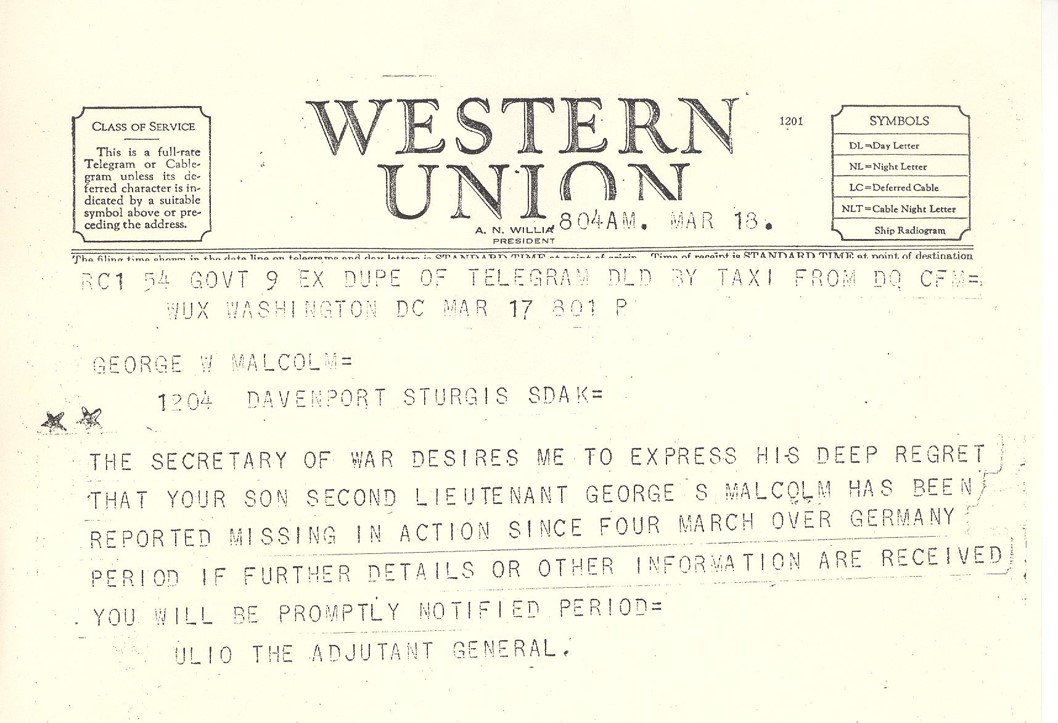
    This telegram his parents received from the War Department began a period of worry during which his mother’s hair turned completely gray.

    GSM Telegram

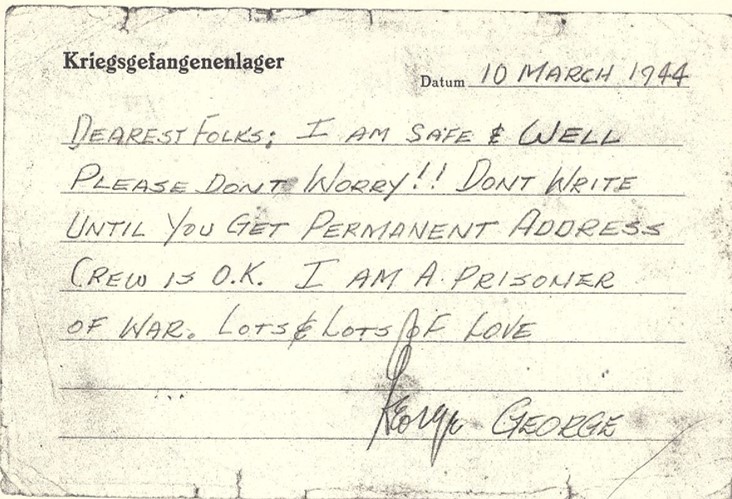
    After three months they finally received this postcard:

    GSM postcard home

    Second Lieutenant Malcolm left a lot of good friends behind in the aerial battlefields, and he finally rejoined them in 2009.

    A new Second Lieutenant Malcolm has just added a second link to the chain. Almost exactly 71 years after the first, my nephew—and George’s grandson—Kirk Malcolm was commissioned a second lieutenant in the United States Marine Corps after graduating Friday from the Naval Academy. That’s him on the right in this picture:

    Kirk grad

    The new 2LT Malcolm enters the service when his country is technically at peace after 13 long years of war. No one can predict the future even a few months out, but the simmering international situation does not promise slow and easy times ahead. Regardless of what the future holds, he and his classmates are prepared to serve their country as courageously and honorably as their fathers and grandfathers did.

    On this Memorial day, we remember those who went before and honor those who serve today.