
 Last week I wrote a post summarizing a Harvard Business Review article, “Tweet Me, Friend Me, Make Me Buy”, by Barbara Giamanco and Kent Gregoire. The article served as a useful wake-up call to the 17% of B2B marketers who don’t use social media at all, and further encouragement and support for the 58% who are in the early stages. Yet, in the short space available to them in the article, they could not give too many specifics, and specifics are where the results will come from.
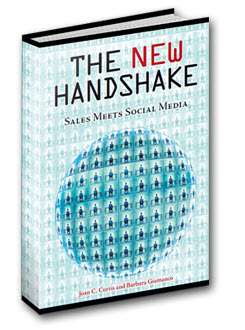
These specific details and suggestions can be found in the book, The New Handshake: Sales Meets Social Media
Part One of the book sets the context for the why. Why do sellers need social media to help them sell? The key point is that “People buy from people they know, like and trust.” In the cold calling days, you had to first get someone’s attention long enough to have a conversation, and then develop a relationship. Today, the relationship comes first, and regular and consistent participation in the social media conversation is the best way to get people to know you, like you, and grow to trust you. The result, in sales terms, is that your funnel becomes much narrower at the top, because suspects are much more likely to be real prospects when they get in touch with you.
Social media also helps you cast a wide net, which is important because of the counterintuitive idea that you’re more likely to get referrals through your weak connections rather than your strong ones. Your strong connections generally run in the same circles that you do, so it’s less likely they’ll hear of something you won’t, and besides, they’ve already referred any business to you that they can.[1]
If you’re already convinced, the rest of the book will hold more interest for you. Yet, if you face the challenge of getting your company leadership to embrace the approach, there is a lot of useful material in here. This may be important because although there is so much that individual salespeople can do on their own, they may run into resistance from corporate policies that seek to keep tight control of any outgoing messaging. That’s a valid concern, and they should have prudent guidelines set up, but the last thing any sales organization can do is avoid social media, because the conversation about them and their products and reputation will go on, with or without them.
As someone who is somewhere in that 58% (using social media but nowhere near as well as I could), I gained a lot of insights and specific ideas from Part Two of the book, in which they describe the major social media outlets and how to get started. Personally, I got some great nuggets from the LinkedIn and social bookmarking chapters. Using my rough guide that if I get one useful idea out of a book, it has been worth the price and time of reading it, if I really stretch the definition of ROI, my own ROI from reading The New Handshake is about 1200%.
However, one should not expect a quick payback on their social media investment. Opening a Twitter account is not going to magically transform your marketing and selling results. Like anything else, (especially if everyone else is jumping on the bandwagon), it’s about execution, patience and consistency. If there’s any secret to social marketing success, it’s the same open secret that applies anywhere: hard work. The difference is that cold calling is also hard work, but in today’s world, it just does not get the same results.
One weakness of the book is probably due to the lack of hard data that was available at the time of publication: there is not enough information to demonstrate measurable ROI from social media selling programs. That has changed in the past two years; it’s easy to find white papers that address this issue, but your time might be better spent getting started on your social media campaign.
[1] If you want to read more, see this excellent article by Don Peppers, Harnessing the Power of Your Weak Ties

He knew where the money was
Are sales presentations dead? In this age of Sales 2.0, it’s easy to get that impression. We’re told that buyers are better informed than ever, that they have already gone through more than half the buying process when they first engage us, and that no one likes to be “sold”.
If this is true, then it would seem there would no longer be any need for a sales professional to know how to deliver a compelling presentation. Maybe it’s a far better use of their time to master social media instead.
On the other hand, that news would be extremely surprising to many top sales professionals who have made their year—maybe even affected the trajectory of their careers—by succeeding in those all-important strategic presentations. What does strategic mean? Quite simply, it’s improving your position (or clinching the deal) by saying the right things to the right people at the right time in the sales process. As an example, a top executive from a major technology firm told me that when a sales team from a major PR firm presented to their top management, within two seconds of their leaving the room, the president said: “Hire them.”
Sales presentations are still crucial to success in the complex sales for several reasons.
- It’s true that your buyers are getting a lot of information from the internet and other sources, and we all know that the information we get on the internet is 100% reliable, right? Whether your buyers are misinformed, or have missed some important insights, often the only way to correct the discrepancy is to gain the attention of the right people early enough in the sales process to be a part of their decision-making conversations.
- Most complex sales don’t end with a single transaction. The sales team must remain closely involved with implementation and ongoing support to ensure that the customer achieves the best possible outcomes from their purchase decision. The sales presentation may be the only way for all the people involved in the decision to get to know and gain a level of comfort with the sales team. You may represent a company that has billions of dollars in assets, but to them you are the company.
- If done right, the strategic presentation is definitely not a one-way transmission of information. It’s a superb way to have an interactive dialogue with all the relevant stakeholders and share insights that lead to better solutions.
- According to research cited in The Art of Woo: Using Strategic Persuasion to Sell Your Ideas, important corporate decisions involve an average of eight people in the decision. Major purchasing decisions will require at least that many, so at some point someone will have to present to all of them together. Why shouldn’t it be you?
- Other research by the HR Chally Group found that salesperson effectiveness accounted for 39% of the buying decisions of 300,000 customers surveyed[1]. A presentation to a high level audience is the most direct and dramatic way of demonstrating your effectiveness.
- Another interesting insight from my interviews with senior-level decision makers is that while they are often not experts in the technologies they are asked to decide upon, they do pride themselves on their ability to read people. They welcome the presentation because it gives them an opportunity to “scratch the surface” in a presentation and gauge the competence of the person presenting to them.
Willie Sutton was a famous bank robber in the 1950s. When he was caught, supposedly a reporter asked him why he robbed banks. Willie replied: “That’s where the money is.” The same still applies to strategic sales presentations today, no matter what some pundits will tell you.
This is leadership?
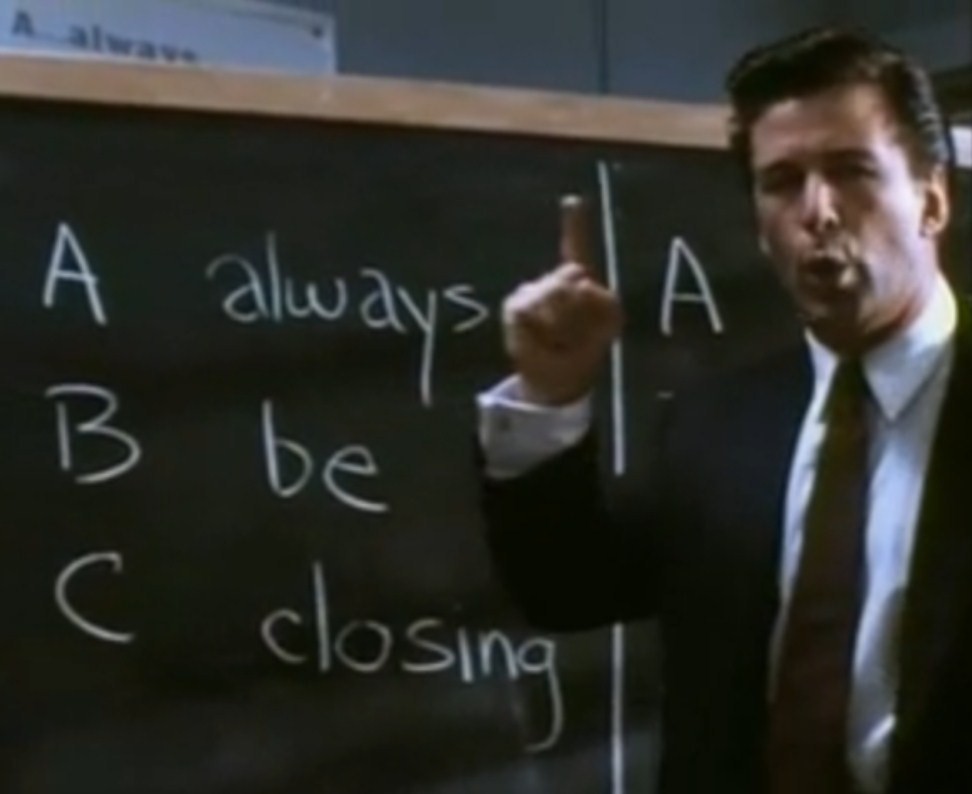
“Leadership” is the sexiest topic in all of business writing, and it’s even more so in sales, with its emphasis on getting the best possible performance out of creative, street-wise and strong-minded individuals. We admire sales leaders like the one personified by Alec Baldwin in Glengarry Glen Ross, who parachute in and solve sales problems through an artful combination of incentives and intimidation. (First prize in the sales contest, new Cadillac; second prize, set of steak knives; third prize, you’re fired)
I think it’s time to point out that this emperor’s clothes are wearing very thin. We need to recognize and promote the sales leader’s quiet and unassuming little brother (or sister): the sales manager. We have too many leaders and too few managers.
There’s a wonderful phrase in Michael Webb’s book, Sales and Marketing the Six Sigma Way: “yelling at the thermometer”. He says that trying to solve sales problems is like trying to fix the temperature by yelling at the thermometer. How many sales “leaders” try to solve sales problems in a similar fashion?
The 4 I’s of Sales Leadership
Sales leaders like to be the indispensable heroes in the middle of the action. They have four major tools that they use as necessary when there is a sales problem:
Intuition: “Analysis is for wusses. I know what worked for me, and by golly, it will work for them.”
Inspiration: “Don’t fire them; fire them up.” (Anyone remember that book from the 80s?)
Incentives: I once worked for a guy who thought the best way to increase sales was to encourage his salespeople to go into heavy debt.
Intimidation: “Of course they’ll use the CRM system. They know what will happen if the don’t.”
There’s nothing fundamentally wrong with any of the tools above, except when they are all you have. Let’s see how sales managers do it.
Who remembers Gus Pagonis?
We all remember Stormin’ Norman Schwarzkopf for his brilliant generalship during the first Gulf War, but it takes a geek to remember the real hero of that war. Gus Pagonis was the logistician who accomplished the astonishing feat of moving, equipping and feeding an army of half a million troops to the Gulf and back again. An Abrams tank without gas is just a hot piece of metal sitting out there in the middle of a desert. His fundamental contribution was to make sure the shooters had everything they needed to do their job.
What does this have to do with sales? A sales manager’s job is to make sure their sales teams have everything they need to do their jobs as effectively and efficiently as possible. This requires systems thinking, systematic problem-solving, and process orientation, and future focus.
Systems thinking: Deming said that “a bad system will beat a good person every time.” The sales manager’s job is to implement and maintain a good system-one that gives the right people the tools they need to succeed and gets out of their way.
Problem-solving: Without systems thinking, problem-solving becomes an exercise in “wack-a-mole”, where you hit any problem that comes up as hard as you can (using the 4 I’s), only to have another problem pop up in a different place. Sales managers take the time to analyze problems, get to the root cause, experiment with solutions, gather data, and keep what works. It’s not as exciting as leadership, but it works.
Process: Sales managers know that one of the most important concepts in sales is process. As Dave Brock tells us, “The data shows that people and organizations that use a sales process consistently perform at much higher levels than those who don’t.” While sales often calls for imagination and flexibility, there is a surprising amount of commonality and standard work in all sales efforts, and codifying and improving this work can improve the entire sales organization.
Future focus: Sales managers build for the long term, so that they can leave behind a system that continues to thrive even after they’ve moved on. For example sales leaders like to ride to the rescue to close an important deal (and show the sales team they still have it); sales managers make sure their people get the right coaching, support and training so that they can confidently close the deals themselves.
If you’re a sales leader and find that you have to keep continually applying the 4 I’s of your trade, maybe you should try to ease up—do a little less leading and a little more managing.

Don’t blame the audience
As part of my research for my forthcoming book, Strategic Sales Presentations, I interviewed dozens of senior level executives to understand how they perceive the presentations they receive from salespeople. One of the questions that really got most of them talking was “What are the top mistakes that you see salespeople making during presentations?” Here are the Top 10:
Try too hard to sell me. When you reach my level, you have been vetted by people in my organization whose opinions I trust, so make your presentation educational and factual. Teach me something new.
Talk too long. “By slide #2, most salespeople have already used up 75-80% of my patience and I’m looking for the exit.” Get to the point. On a related note, don’t use too many slides, especially about your corporate “story”. Sometimes even you look bored with it.
Ask me what keeps me awake at night. That’s one of the most overused questions in sales. You should already have a pretty good idea of my problems.
Be too sure that you know all about my problem already. This is the opposite extreme of the previous one. If you act like you know it all, we will push back and expose what you don’t know. Be humble and ask a lot of questions.
Not listen. Don’t be so wrapped up in getting your message out that you don’t listen to us. If we interrupt you to ask a question or say something, there is a pretty good reason for it.
Try to circumvent our buying process. “Don’t force your sales cycle on me.” On rare occasions, we will bend this rule, but you’d better have a damn good reason to do it. Also, “If you get in too easily to see me, that’s not a good sign. It means everyone else can too.”
Be too canned. We like to talk to real people who know our business. If you’re too slick or too “coiffed”, we’ll get suspicious.
Use “$75 words”. When you make something more complicated than it is, it “makes us think like you’re full of it.” On a related note, a CFO said that you should not use terms like ROI and payback unless you really know what they mean.
Bring too many people. Too many teams bring in many more people than are necessary. If they don’t have a reason for being there, or don’t play an active role, leave them home. If you have that many people to spare, I may end up paying too much.
Wear a Gator tie when selling to the University of Georgia. Yes, this actually happened. The big picture point is that you should know your customer and tailor your presentation to them. On a related note, don’t show me a generic slide presentation that could have been seen by anybody.