Read it fast, and then again slowly
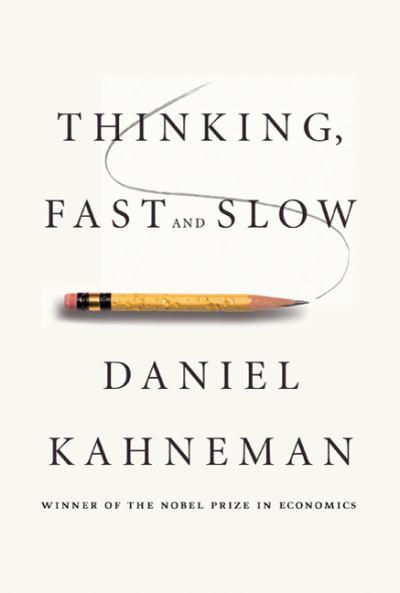
One of the highlights of my intellectual life was discovering the work of Daniel Kahneman and Amos Tversky, in a book called Against the Gods, by Peter Bernstein. Since then, I’ve read some of his more scholarly work and have come across his name in dozens of books about thinking and decision-making. So, when I learned that he had written Thinking, Fast and Slow
As a fan of his work, it’s a sure bet that I am biased, but as a student of his work I have taken special pains in this review not to let that bias affect my thinking. Fortunately, this time both my intuition and reason agree that it is an important book for anyone who wants to learn more about the complexities and oddities that characterize our thinking, perceptions, and decision-making.
The key theme of the first section of the book is that we all have two currents of thought running simultaneously in our heads. Think of a hybrid engine, which runs quietly on electrical power in leisurely driving but requires gasoline power for surges of performance. System 1 thinking is equivalent to the electrical power. It’s fast and effortless and mainly runs below the level of our consciousness. System 2 is slower, more logical, and often difficult to use.
Clear thinking is hard to do and rarer than we think. Our brains use a disproportionate share of our energy resources, so we’ve evolved brains that conserve mental energy as much as possible. One of the ways we do this is by taking mental shortcuts (heuristics) to quickly arrive at “good enough” answers for most of life’s questions and challenges. System 1 generally serves us well.
Except when it doesn’t. In complex situations those shortcuts can take us in the wrong direction. When faced with a difficult question to answer, one of our most common shortcuts is to substitute an easier question. For example, the question: “Will this multimillion dollar investment deliver an ROI that exceeds our hurdle rate?” often becomes, “Do I trust this person who says it will?”
You can see the obvious implications for persuasion, regardless of which side of the persuasion attempt you’re on.
Another important idea is What You See Is All There Is, (WYSIATI). Even when we don’t have complete information to answer the difficult question, we often treat the information we have as all we need. One consequence of this is the halo effect, in which a salient judgment about a specific person carries over into other judgments. For example, people who are perceived as good-looking tend also to be seen as more intelligent, capable, etc.
We are remarkably good at some types of judgments, such as inferring the intentions of another person from a momentary glance. But we are also bad at other types of judgments, such as statistical thinking and some economic choices. In the second main section of the book, Kahneman shows us how our judgments deviate from the utility-maximizing “best choices” that economists tell us we should make.
I’ve written before about loss aversion and framing effects because of their close connection with persuasion. So often, it’s not the choice that makes the difference, but how the choice is described. For example, consider the following scenario.
A person with lung cancer can choose between radiation and surgery. Surgery has a better record for long term survival, but it is riskier in the short term. In studies, participants were given either of the following two descriptions:
- The one-month survival rate is 90%.
- There is 10% mortality in the first month.
Which would you choose?
Participants in the studies chose surgery 84% of the time when the first choice was posed, and only 50% chose it in the second frame. The choices are exactly the same, but the description makes a big difference. Disturbing, but maybe not surprising.
What was most surprising about the studies is that the framing effect applied equally to physicians as to the general population.
What makes so many of these errors especially sinister is that we are overconfident in our own certainties and abilities. In fact, often the people who are most wrong are in the worst position to know it.
As you can see, education is not enough of a guard against irrationality. It would be nice if Kahneman would have given us some practical advice on how to improve our judgments, but he tells us that “little can be achieved without a considerable investment of effort.” If you read this book, you will at least be in a better position to recognize situations where you should be on your guard and should make the extra mental effort to think through the choice.
There are many excellent books that have come out in recent years, but most of them are based on the original thinking and research done by Daniel Kahneman, so why not go directly to the source? Most people I talk to have never heard of Kahneman, and I didn’t want to tell you more about him until you had a chance to react first to some of his ideas. I guess I should mention that he is the only psychologist ever to have won the Nobel Prize for Economics.
In this brief review, I’ve only scratched the surface of the dozens of examples of the ways our thinking can go astray. Although most of the judgments and choices we make turn out alright, sometimes we need the extra horsepower that System 2 can provide. Any serious student or practitioner of persuasion—or of thinking clearly and resisting persuasion—should read and re-read this book.

Numbers can be very persuasive–if used properly
It’s pretty hard to give a business presentation without numbers. But if you think words can be tricky, numbers present their own special challenges. It would seem that there could not be anything more definite than a number—after all, 100 is 100 no matter what language you use. Just like words, they mean different things to different people.
When you decide to use a number in your presentation, there are two important principles to keep in mind. The first principle is that numbers carry meaning beyond simply quantifying something. The mere use of numerical data in a presentation sends important signals to the audience. It tells them that you are competent—you have solid information to back up your sales pitch. It tells them you are prepared, because you have taken the time to gather the data.
A surprising statistic can make an impression on someone’s mind during your presentation. If they have to rely on memory a few days later to make the decision, they are far more likely to remember the impression than the number itself. In fact, researchers have shown that they may actually rely on the memory of the impression and then reconstruct a number in memory that matches what they felt when they heard the number!
The second principle is that numbers are meaningless except in relation to something else.

It’s hard to talk for long with one of these on your head.
We like to think that our fast-paced world poses unique challenges to presenters because of the audience’s impatience, but actually the need for brevity has been respected for thousands of years. One of the earliest stories about public speaking is found in Herodotus, roughly 2,500 years ago.
If you think senior level audiences can be tough, imagine being an official from the city of Samia having to ask the Spartan authorities for aid after being driven from their city by the Persians. The Spartans, besides being fearsome warriors, were also renowned for their love of brevity.
When the delegation first spoke, they spoke so long that the Spartans said they had forgotten what they said at the beginning and didn’t understand the rest.
The Samians tried again, this time bringing an empty sack and simply saying: “this sack needs barley meal.” The Spartans applauded their brevity and approved the request, although they did say the word “sack” could have been left out.

You don’t want to carry authenticity too far.
An article in last Sunday’s New York Times discusses the current trend to tout the importance and value of being “authentic”. As it says, “Authenticity seems to be the value of the moment, rolling off the tongues of politicians, celebrities, Web gurus, college admissions advisers, reality television stars.”
The funny thing is, it seems to me that if you have to tell people you’re being authentic, you’re already in a bit of a hole.
The trouble with all this talk about authenticity is that ordinary people might take it seriously when they’re trying to persuade. Keep in mind that the types of people listed in the above quote are trained professionals on a closed course. You should not try this at home. What they are really doing is called “calculated authenticity”, which reminds me of the old joke that sincerity is everything; once you can fake it, you’ve got it made.
If you want to be an effective persuader, you must at least try to master the art of calculated authenticity.