Going Deep
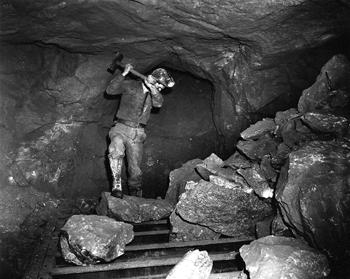 Forty miles from Johannesburg SA is a vast gold mine called Mponeng, and it’s the deepest manmade hole on earth, according to a fascinating article in last month’s WSJ. It is so deep that one elevator does not reach to the bottom, because the steel suspension cable gets heavier with every foot descended. It is so deep that the cold winter temperature at the surface increases to 140 degrees at the bottom. The entire three mile journey to the bottom takes an hour. But it’s the only way to get to where the gold is.
I’ve learned that with some tasks, it takes about that long to get deep enough to where the gold is. In my case, it’s usually writing an article or working on my book, but it also applies to solving problems, strategizing, or just about any task that requires quality thinking. It’s why I’ve learned to schedule my writing in time blocks of 90 minutes; it takes that long to get deep enough to where the good thoughts come.
I often begin an article with an idea that I want to flesh out, and frequently the first outline comes quickly enough. Filling in the words and choosing the right metaphors and stories takes a little longer. But all told, I can often churn out an average article in 30-45 minutes.
Yep, average.
But who wants to be that? The rich veins of gold lie much deeper. It’s easy to skim the surface of the trite and true in the first couple of passes through an idea, but it takes time to go deeper. Deeper is where the new ideas come from. Deeper is where your mind starts freeing up some half-buried memories that suddenly seem to be exactly the right analogy you’re looking for. Deeper is where just the right word or turn of phrase presents itself, like an old friend who turns up unannounced at your door. Deeper is where the hidden connections between seemingly unrelated ideas reveal themselves. Deeper is where insight lurks.
In fact, as I’ve thought deeper about it for this article, I’ve realized that there are generally four layers to a deep session:
- The first layer is the Distraction Zone, where you still haven’t cleared your head of other thoughts or your previous tasks. Plenty of research[1] has shown that there is a cost involved in switching between tasks because our minds have trouble quickly locking in to a task after an interruption.
- The second layer is the Cliché Zone, where all the easy thoughts are found. Some ideas come quickly to mind, but they come up first precisely because they are the most common, so you haven’t really created anything new or worthwhile.
- The third layer is the Struggle Zone, and it’s where most of the real work gets done. When you realize that the clichés are not good enough, you struggle to think of better ideas. You may stare at the screen for minutes on end trying to come up with just the right word, spend time re-writing sentences or rearranging paragraphs, or deleting entire blocks of text—sometimes you delete the whole thing and start over. It’s hard, frustrating, very discouraging, and absolutely necessary, because this is where you stretch. You’re not just dredging up old ideas, you’re creating new ones.
- The fourth layer is the Flow Zone, where you break through to the gold beneath, and the ideas start coming fast enough that you’re not always sure you can keep up, and you eventually look up and realize that an hour has gone by and you’ve actually produced something you’re not entirely embarrassed to show to the world.
- Actually, there’s an unofficial fifth layer, and it’s a free added bonus. After your deep session, your subconscious mind keeps working, and new ideas or refinements will pop into your mind at the oddest times.
(Of course, this is totally unscientific, being based on a sample size of one and recorded by a biased observer. But Cal Newport, who has studied this more deeply than I have, tells us that that notable creative people spent an average of 5.25 hours per day in deep work.)
Going deep is not easy, but I suppose that’s precisely the point, isn’t it? Here are some suggestions to get more deep work done:
- Cultivate a ritual. Rituals are a great way to prime your mind and get through the Distraction Zone.
- Set time blocks. Make an appointment with yourself and keep it. Just make sure you have buffer times set up between blocks to deal with all the unplanned stuff that will come up. I find that 90 minutes works for me, although I’m planning on increasing that.
- Use the nothing alternative. If you don’t feel like it, you don’t have to write, or plan or think about your problem during your time block, but you’re not allowed to do anything else during that time.
- Record your sessions and time. It will keep you honest, and especially works well if you’re competitive with yourself.
One final note of encouragement: like training for a marathon, it gets easier over time. But you have to start.
[1] Worker, Interrupted: The Cost of Task Switching, Kermit Pattison, Fast Company
No Task Left Behind? Examining the Nature of Fragmented Work, Gloria Mark, Victor M. Gonzalez, Justin Harris
Related Posts